Orthopedic surgery is undergoing a genuine (r)evolution thanks to robotics. Far from replacing the surgeon, these technologies offer an unprecedented level of precision and control, enabling improved intra- and post-operative results.
Robotic surgery: ultra-precision
Robotic surgery involves fine-tuning the surgeon’s movements using collaborative robots capable of measuring, planning and adjusting each gesture with minute precision. In some technologies, digital planning is used to reconstruct the patient’s anatomy in 3D before the operation, to anticipate surgical constraints and simulate the final result.
The robotic systems used in orthopedic surgery today illustrate this evolution. Platforms such as the Mako distributed by Stryker, for example, enable the planning and execution of hip or knee implants, with robotic assistance guiding the surgeon’s actions while maintaining total control over the operation.
Focus on digital planning and robotic assistance
Digital planning is central to robotic surgery. The software associated with the robots enables us to reproduce the patient’s anatomy, define the exact location of implants or prostheses, and simulate the surgical gesture to reduce risks. Robotic execution follows this planning, accompanying the surgeon with precision throughout the procedure.
Robotics is gradually accompanying the transformation of orthopaedic surgery. Long considered an experimental technology, it is now becoming a tool capable of increasing the precision of surgical gestures and optimizing the planning of interventions. This development is part of a wider transformation in medicine: the rise of personalized, data-driven surgery.
European innovation accelerates
Companies like Amplitude Surgical, with its robot Andy developed in collaboration with eCential Robotics, are developing solutions dedicated to knee arthroplasty, integrating navigation and robotic assistance to optimize bone cuts and ligament balancing.
In the same spirit, the ROSA platform developed by Zimmer Biomet illustrates the evolution of robotic systems towards ever more integrated surgical environments, capable of combining preoperative planning, navigation and intraoperative assistance.
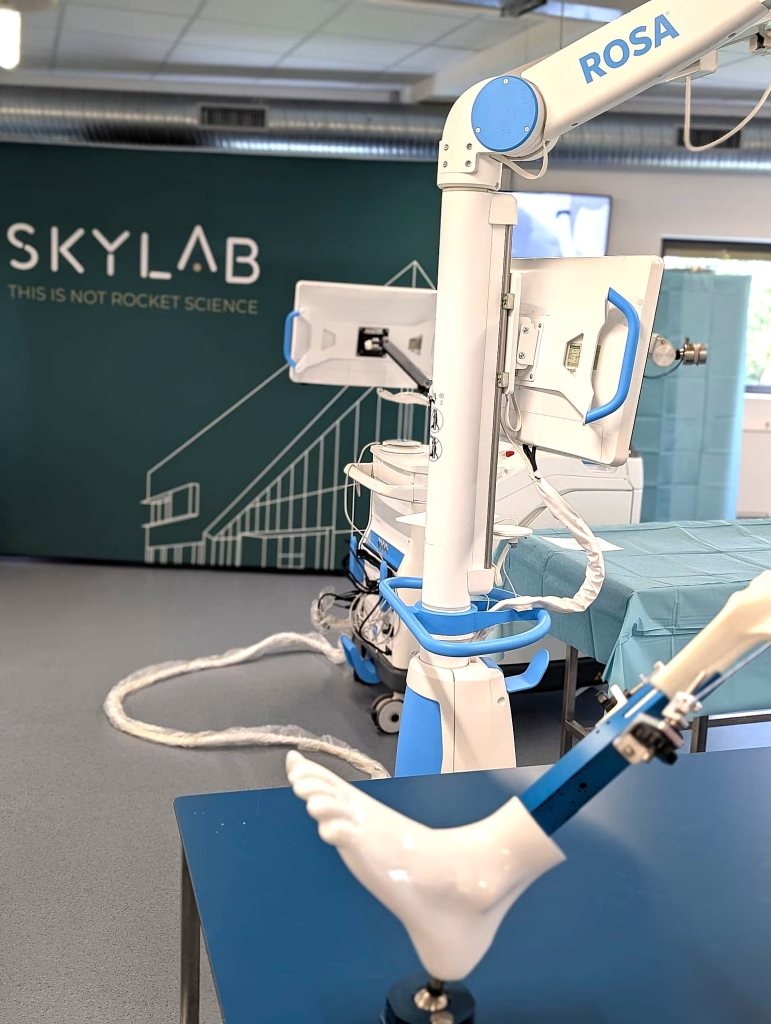
European dynamism is also evident in new technology companies. French company Ganymed Roboticsfor example, is developing co-manipulated robots integrating computer vision and artificial intelligence to assist the surgeon in certain key stages of knee arthroplasty.
Considerable benefits for both patient and practitioner
The benefits for patients are tangible: reduced margins of error, fewer post-operative complications, better tissue preservation and faster return to mobility. For surgeons, these technologies mean more reliable planning, better-guided intervention and reduced physical fatigue on long or complex procedures.
Training: a key factor in the adoption of robotics
Robotics may open up promising prospects, but it also implies changes in surgical practices and training courses.
Surgeons must not only master the traditional surgical gesture, but also understand digital planning systems, robotic interfaces and personalized alignment strategies.
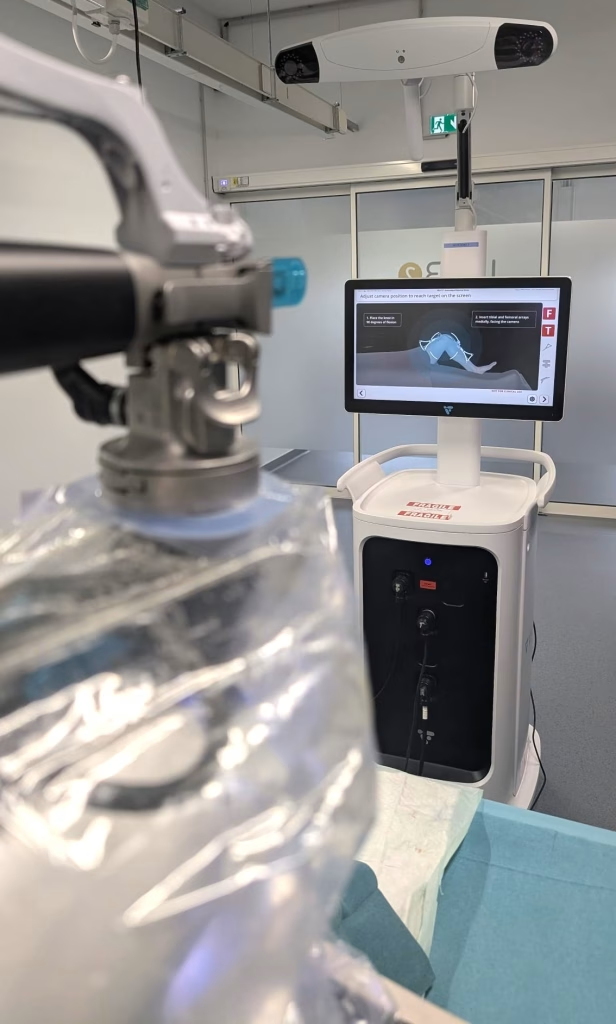
This is why Depuy Synthes has chosen Skylab, in France, to train surgeons in the use of the Velys to assist in the fitting of unicompartmental and total knee prostheses.
Surgeons can then discover the technology, explore its preoperative planning software and perfect their surgical gestures assisted by the Robot in an educational environment close to real surgical conditions.
Other medical specialties are also seeing their practices evolve. Particularly since the advent of the Da Vinci remote manipulator for minimally invasive digestive operations, and other solutions for urologists, gynecologists, oncologists and others.